
Valued at $71.2 billion, the bank's market capitalisation is more than that of global banks like Barclays, JP Morgan Chase and Credit Suisse.

Banks, through the Indian Banks' Association, have urged RBI and credit information companies to maintain a database of wilful defaulters.


With strong long-term fundamentals, banking sector cannot be completely ignored

'We do not know when we will get to the business-as-usual mode.' 'Many borrowers may not be able to pay up.' 'The incidence of cheque bouncing has doubled or even trebled, some lenders say,' says Tamal Bandyopadhyay.

Uttar Pradesh and Punjab have announced loan waivers for farmers, while Maharashtra has not despite Opposition pressure. Sanjeeb Mukherjee reports.

Punjab National Bank has the largest share.

All banks are eligible for privatisation. A committee of secretaries will decide which banks will be privatised, says Financial Services Secretary Debasish Panda.
At a time when the asset quality of state-owned banks is deteriorating, the Reserve Bank of India is also planning harsher penalties for wealthy promoters of wilful defaulters.

'If anybody defaults on something which is due for today, they have to disclose it tomorrow.' 'The accumulation of NPAs is due to asymmetry in information.' 'The investor should have real-time information.'

While lenders create a hype around the services offered on digital platforms, customers think otherwise, given that frustration due to the quality of service has only increased, over the years.

The finance minister has said that United Bank has managed to reduce its non-performing assets.

The Finance Ministry has called a meeting of heads of public sector banks to clear stalled projects.

Independent market analyst Ambareesh Baliga points out the red flags that retail investors should not have ignored and lists three scenarios -two of these scenarios offer a glimmer of hope to retail shareholders of Yes Bank - that could play out in the coming days.

NPA problem to continue for next 2-3 quarters: banks to FinMin

Its total income during the September quarter also slipped to Rs 30,191 crore, as against Rs 32,435 crore in the year-ago period
Public sector banks (PSBs) have written off a massive Rs 8 trillion of loans in the seven years of the Narendra Modi government in office. This is more than twice the capital infused by the Bharatiya Janata Party-led government during the period. Between 2014-15 and 2020-21 (FY21), the Centre had infused Rs 3.37 trillion into PSBs. At Rs 1.06 trillion, FY19 saw the highest capital infusion.

Gross Non-Performing Assets rose to 12.90 per at the end of March, from 6.55 per cent a year ago.

The coming years could be exciting for Bandhan Bank, IDBI Bank, IDFC First Bank, Federal Bank, and CSB Bank.

It adds that banks could be hiding some of the fraud cases, masking these as bad debt

In addition to challenges such as reining in non-performing assets (NPAs) and boosting profits, Chaudhry will have to repair the bank's reputation, build internal controls, and improve regulatory relations.

Joy Thomas stated that one large account -- HDIL -- was the sole reason for the present crisis that led to the regulatory action on Tuesday when Reserve Bank of India superseded its management and placed it under an administrator for the next six months.
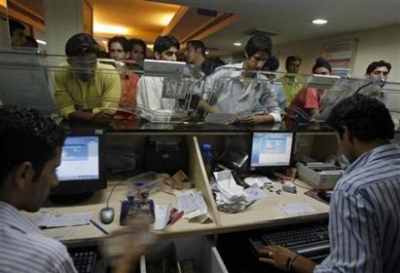
'Confidentiality needs to be maintained.'
The bank expects to grow loan book by 10 per cent in the current financial year with calibrated exposure to corporate accounts and thrust on the retail segment.

The crisis in Indian banking has now reached a point where the NPAs of many public-sector banks are higher than their net worth

Yes Bank CEO said the private lender is disposing some of the properties in many other cases as well. He, however, declined to elaborate on borrowers against whom such action was underway.

Despite multiple headwinds at the start of 2023, the Indian markets delivered a strong performance, posting 19-20 per cent growth for the year. Even as new records were set, investor sentiment remains strong going into 2024, given the lower inflation, expectations of steady to lower interest rates, higher economic growth, and strong inflows. However, the overriding concern for most brokerages is valuations.

Rajan said it is hard to offer an objective self-assessment but the RBI should probably have raised more flags about the quality of lending in the early days of banking exuberance.
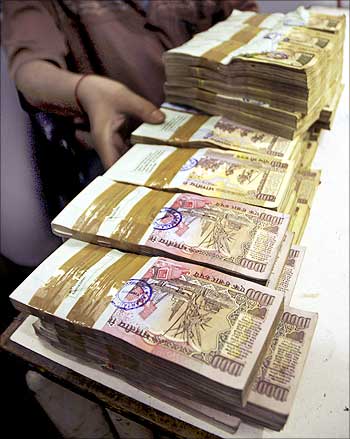
Bad loans in public sector banks more than tripled.

As of June, the gross NPA of nationalised banks was 3.89 per cent and State Bank Group at 5.50 per cent.

The new circular provides for a framework for early recognition, reporting and time-bound resolution of bad loans.

The Reserve Bank on Thursday asked banks to improve their ability to manage stressed assets, but said there was nothing alarming about an unexpected rise in the non-performing assets (NPA) levels this fiscal.

The mergers will not involve any cash but only share swaps

Mark-to-market risks to the Indian banking sector are limited and manageable, says RBI

The RBI has cited corporate governance and regulatory issues for not extending Kapoor's term. Further, the lender has been directed to search for a successor.

A few state-owned banks such as IDBI Bank, Union Bank, Indian Overseas Bank have announced results for FY14.

Many are now cheaper after stock splits. But look at key parameters

According to the RBI's Financial Stability Report, the industry's gross bad-loan is at a 14-year high. As RBI's March 2017 deadline for banks to clean up soured credit looms closer, Shailajanand Mishra takes stock of just how bad the situation is.

The bank may post a loss of Rs 1,000 crore during October-December 2019-20 quarter, an analyst commented.
The need to allow government shareholding in public sector banks to come down below 51 per cent
